terça-feira, 8 de novembro de 2022

Julgamento


Tommy Ingberg


Não julgues…
Habitas num recanto mínimo desta terra.
Os teus olhos chegam
Até onde alcançam muito pouco…
Ao pouco que ouves
Acrescentas a tua própria voz.
Mantém o bem e o mal, o branco e o negro,
Cuidadosamente separados.
Em vão traças uma linha
Para estabelecer um limite.

Se houver uma melodia escondida no teu interior,
Desperta-a quando percorreres o caminho.
Na canção não há argumento,
Nem o apelo do trabalho…
A quem lhe agradar responderá,
A quem lhe agradar não ficará impassível.
Que importa que uns homens sejam bons
E outros não o sejam?
São viajantes do mesmo caminho.
Não julgues,
Ah, o tempo voa
E toda a discussão é inútil.

Olha, as flores florescem à beira do bosque,
Trazendo uma mensagem do céu,
Porque é um amigo da terra;
Com as chuvas de Julho
A erva inunda a terra de verde,
e enche a sua taça até à borda.
Esquecendo a identidade,
Enche o teu coração de simples alegria.
Viajante,
Disperso ao longo do caminho,
O tesouro amontoa-se à medida que caminhas.


Rabindranath Tagore


...................... se eu tiver que te pedir, já não quero mais


Frida Kahlo e Diego Rivera


Não vou te pedir que me dê um beijo, nem que me peça perdão quando creio que você não fez bem ou que se equivocou. Tampouco vou te pedir que me abrace quando mais o necessito ou que me convide para jantar no dia do nosso aniversário.

Não vou te pedir para recorrer o mundo juntos, para viver novas experiências e, muito menos, vou te pedir que dê a mão quando estivermos na metade da cidade.

Não vou te pedir que me diga o quão bonita estou, ainda que seja mentira, nem que me escreva nada bonito. Tampouco vou te pedir que me chame para me contar como foi seu dia, nem que me diga que tem saudades de mim.

Não vou te pedir que me agradeça por tudo o que faço por você, nem que se preocupe por mim quando meus ânimos estão pelo chão e, obviamente, não te pedirei que me apoie em minhas decisões. Tampouco vou te pedir que me escute quanto tenho mil histórias para te contar.

Não vou te pedir que faça nada, nem sequer que fique a meu lado para sempre…

… porque, se tenho que te pedir isso, já não quero mais.

Frida Kahlo


sábado, 5 de novembro de 2022

THE SEVEN ROOT RACES OF MANKIND


We are going through a big time of transformation and change which explains the arrival of the Covid19. This is the planet somehow doing a natural cleansing and shaking up Humanity to awaken... It's the End of the Old World, the whole order of Human life and our planet is changing where everyone has to step up to a new moral way of being.
We are transitioning to the six root race.


There are seven Root-Races or evolutionary cycles through which humanity evolves. 
Each root-race is divided into seven minor cycles called sub-races, which are again subdivided into seven branch or family races. These sub-divisions are related to the modern concept of races and ethnicities.

     It must be stressed that the sub-races refer to cultural qualities and not to the level of evolution of the soul, they are different evolutionary stages humanity as a whole goes through successively. 

The same individuals that compose the current humanity have been reborn in all the previous Root-Races.

    We are presently at the fifth stage, referred to as the "Aryans".  
Aryans (the word means "noble" in Sanskrit) were the original Indo-European nomadic tribesmen, a war-like race of horsemen that moved east to India and West into the near East and Europe. 

Historians argue that when they got to Europe they destroyed the peace-loving earth-wisdom pagan matriarchal societies and replaced them with war-like sky-god worshipping patriarchal societies such as we still have today. 

    It is unfortunate that the term "Aryan" was adopted and perverted by Hitler and his intellectual predecessor's fantasies of an "Aryan Superman”, and is still used today by right-wing white power extremists.  Hitler and his inner circle also perverted some genuine ancient symbols, like the swastika (an ancient Sanskrit symbol) by using it in a counter clockwise position. However, the Swastikas in India, Tibet, and elsewhere are also sometimes represented counter-clockwise as well as clockwise. 

    There have been on Earth many civilizations of which we know nothing. These Races evolve from ethereality to materiality, and from the latter back again so every living organic species of animals and vegetation changes with every new Root-Race.

   Every sub-race and nation have their cycles and stages of developmental evolution repeated on a smaller scale. Our race then has, as a Root-race, crossed the middle line of the Root Races and is cycling onward on the Spiritual side; but some sub-races still find themselves on the shadowy descending arc of their respective national cycles; while others again, the oldest, having crossed their crucial point (which decides whether a race, a nation, or a tribe will live or perish) are at the apex of spiritual development as sub-races.

    The seven Rounds decrease and increase in their respective durations, as well as the seven races in each. Thus the 4th Rounds as well as every 4h race are the shortest, while the 1st and 7th Rounds and the 1st and 7th Root Races are the longest. Each Root-Race succeeds another, although there is a period of overlapping between the old forms dying out and the new forms beginning to become more and more dominant. 

    The timespan applied to a root race is considerable. For instance, the Fifth, according to Theosophical records, covered the years 10,000 BCE to 3,000 BCE in right-brained megalithic cultures and 3,000 BCE to 2,400 CE in left-brained modern cultures.

    The periods of the great root races are divided from each other by great convulsions of Nature, and by great geological changes. Every root-race is separated by a catastrophe, a cataclysm—the basis and historical foundation of the fables woven later on into the religious fabric of every people, whether civilized or savage, under the names of “deluges,” “showers of fire”, ‘great floods” and the like .

    Our present continents have been submerged and had the time to reappear again, and bear their new groups of mankind and civilization; and that, at the first great geological upheaval, at the next cataclysm, in the series of periodical cataclysms, that occur from the beginning to the end of every Round, our known continents will go down, and the ancient continents will arise again.

​    When reading below it must be remembered that the Theosophical concept is that Souls develop through an evolutionary process from :

​                           1. Mineral, to;
​                2. Plant; to
​                3. Animal; to
​                4. Human.

There is no transmigration backward so that a human cannot go backwards to an animal, etc.

​    The description below skips the first step (Mineral), and starts with a step (Polarians) after mineral. It then goes directly to the Second Root Race which describes the human soul evolving within rudimentary animals (algae, etc. to the first human like form).

    The Third Root Race describes a giant Human Cyclops Race which evolves and ends with the start of the first modern human form of Man. 

    The Fourth Root Race starts with a race of two eyed Giant Humans, beginning about 60 feet tall then decreasing to 20 to 30 feet tall ,which got progressively smaller until they reached modern Human size.

​    We are currently in the Fifth Root Race where humans are normal modern size .
The third eye of the Cyclops has been absorbed over time into the brain. 
Some describe the third cyclops eye to be the Pineal Glad of the brain or what today is known as the "Third Eye" of modern humans.

However modern science believes that it is more likely the Visual Association Cortex and the Parietal Cortex and the Prefrontal cortex, all higher cognitive processing centers of the brain, are the absorbed third eye.


ROOT RACES OF THEOSOPHY 

1) Polarians -
               The first root race was primarily spiritual (Astral/Etheric), and did not leave physical remains.

2) Hyperboreans – 
The second, Hyperborean root-race (a continuation of the first) was semi-astral, but grew denser and more opaque with each passing age. Towards its end, it became more gelatinous and filamentoid in structure, and developed the rudimentary beginnings of bones and organs, hair and skin. Although still more or less ovoid in form, it began to show the first outlines of the later human form. However, towards its end, its bodies passed through many curious, part-animal forms. 
 
3) Lemurians –
The Lemurians were the first with physical bodies.  They were described as a race of three eyed giants and inhabited a "lost continent" of Lemuria which is where the Indian and Pacific oceans now are.  Modern theosophists sometimes identify Lemuria with the actual ancient supercontinent of Gondwana. Others may refer to it as "Mu".
 
4) Atlanteans – 
             
  The Atlantean Root Race includes the following sub-races:
1) Rohmahls
2) Tlavatlis
3) Toltecs
4) First Turanians
5) Original Semites
6) Akkadians
7) Mongolians
 
5) Aryans  
                
The constituent "sub-races" of the Aryan (5th or present) Root Race include the following:
1) Hindus
2) Sumerians
3) Egyptians
4) Hellenes (Greeks & Romans)
5) Europeans
6) Nova men
7) Indigo Children & Star Children

6) 6th Root Race (Seal) 
 
7) 7th Root Race (Trumpet)

NOTE: At the end of the Seventh Root Race the Human period of activity on Earth will cease and a planetary period of rest will begin. The Human Life-Wave will then transfer to Mars (Globe E). 


 EXPLANATION OF THE ROOT RACES​ 
According to Madame Blavatsky 


 First Root-Race
 POLIRIANS

    The fourth round began some 320 million years ago towards the end of the Precambrian Era, a period marked by tremendous geological upheavals. 
The first of the seven root-races or humanities was a race of astral entities and appeared in mid-Paleozoic times, some 150 million years ago. As the seven classes of human monads from globe C started to arrive on globe D, they awakened the corresponding classes of shishtas, which began to multiply in number. The first subrace of the first root-race therefore consisted of seven groups, seven embryonic astral humanities, evolving on seven different zones of the first continent, situated around the North Pole.

    Theosophy therefore teaches ‘the simultaneous evolution of seven human groups on seven different portions of our globe’ (SD 2:1). Strictly speaking, it teaches a modified polygenesis.

    For, while it assigns to humanity a oneness of origin, in so far that its forefathers or "creators" were all divine beings – though of different classes or degrees of perfection in their hierarchy – men were nevertheless born on seven different centers of the continent of that period
Their potentialities and mental capabilities, outward or physical forms, and future characteristics, were very different. ... Some superior, others inferior, to suit the karma of the various reincarnating monads which could not be all of the same degree of purity in their last births in other worlds. This accounts for the difference of races ... (SD 2:249)

    The earth on which the first race lived was more ethereal than it is today, but relatively hard and condensed in comparison with those non self-conscious ‘human’ protoplasts. 

They had huge translucent or transparent bodies, ovoid though somewhat fluid in form, with no bones or organs, and no hair or skin. They slowly grew more solid, but remained ethereal until the end.

    The race was sexless and propagated by fission: a large portion of the body separated itself and grew into a duplicate of its parent, much as happens with living cells today. In contrast to the huge and highly ethereal cells of the first race, our physical bodies today begin their existence as a microscopic cell or egg, a speck of gelatinous protoplasm, which slowly hardens and grows into the human form.

    The first root-race probably originated 130 to 150 million years ago in the Silurian or Devonian period, or possibly in the Carboniferous period, of the Paleozoic era, and ended in the Permian period. 


Second Root-Race
 HYPERBOREANS
 The second root-race originated in the late Carboniferous or in the Permian, and ended in the late Triassic or early Jurassic of the Mesozoic (Secondary) era (some 25 to 30 million years ago).

    The second, Hyperborean root-race (a continuation of the first) was semi-astral, but grew denser and more opaque with each passing age. Towards its end, it became more gelatinous and filamentoid in structure, and developed the rudimentary beginnings of bones and organs, hair and skin. Although still more or less ovoid in form, it began to show the first outlines of the later human form. However, towards its end, its bodies passed through many curious, part-animal forms.

    The second race was asexual and reproduced by gemmation or budding, a method of reproduction still found in certain unicellular organisms (e.g. certain bacteria, yeasts, and protozoans). This was a repetition in the small of the method of reproduction of the first race. A swelling would appear on the body of one of these entities, and as it grew it became constricted near the point of junction with the parent body. Eventually, the remaining filament would break, thus freeing the bud, which then grew into another individual similar to its parent. At about the midpoint of the second race, these buds increased in number, and became what might be called "spores" or "seeds". At certain seasons many of these buds would leave the parent body, as do the spores or seeds of plants today. Many might perish, but many others would successfully grow into beings with bodies like those of the parents which gave them birth.

    The first two races were not fully human as they had no self-conscious minds. Their consciousness was like that of someone in a daze or deep daydream. They were guided by spiritual instinct, and were mentally much like little children.


Third Root-Race
  LEMURIANS

 The third, Lemurian root-race appeared during the Triassic period of the Mesozoic era (which began some 44 million years ago). The jelly-like substance of the second race had now become tender flesh composed of cells. Some of the filamentoid parts grew more cartilaginous, and finally became bones, and others became the muscles, nervous system, and blood vessels. The nuclei that existed in the bodies of the second race condensed into true organs. The evolution of physical humans out of the astral races of the early Lemurian age can be likened to the materialization of ‘spirits’ (astral entities) in the séance room.

    The early third root-race was hermaphrodite or androgynous. This method of reproduction is still found in certain representatives of the lower kingdoms, e.g. in most flowering plants and in invertebrates such as worms, snails, and slugs. Practically all antiquity taught that mankind must have had bisexual ancestors if for no other reason than that each sex possesses rudiments of the reproductive organs of the other sex.

    In the earliest stages of the third race reproduction took place by budding, which developed into "egg-laying": vital cells were exuded from the outer parts of the body, and collected together to form huge ovoid aggregates or eggs. To start with, the drops of vital fluid were exuded from nearly all parts of the body. Later a single large cell was exuded from a functional part of the organism, which was the root of the later reproductive organs.

    Egg-laying is still found in birds and certain reptiles today, and even in humans the method of reproduction is still essentially the same. The human germ cell is an egg, though microscopic in size in comparison with the large eggs of the third race, and it is incubated in the womb, within a protecting wall of solid flesh and bone, rather than developing outside the body. The period of "incubation" is now nine months rather than several years, and the new-born babe is not as independent as the ‘newly hatched’ infant of the third race.

    The first, second, and earliest third races did not eat as we do now, but took material into the body for nutrition by osmosis, in much in the same way as our lungs draw nutrition from the air.

    The first root-race and much of the second knew no death as we understand it; each generation melted into the next. Towards the end of the second race, its individuals fell asleep, as it were, and faded out, and this was the beginnings of what we now call death. With the third root-race, death became the rule, since the bodies became sufficiently solidified and individualized to die when their store of vital energy had been exhausted.

    The third (Lemurian) root-race lived during the Triassic, Jurassic, and Cretaceous of the Mesozoic (the Age of Reptiles). The middle of the third root-race occurred about 18.5 million years ago (near the Jurassic/Cretaceous boundary), when the separation of the sexes and the awakening of mind took place.

    Mme. Blavatsky wrote:

    "Now compare the evolution of the Races, the First and the Second of which are of the nature of Atma-Buddhi, their passive Spiritual progeny, and the Third Root-Race shows three distinct divisions or aspects physiologically and psychically: the earliest, sinless the middle portions awakening to intelligence; and the third and last decidedly animal: i.e., Manas succumbs to the temptations of Kama."

    The continent in which this Root-Race lived is called Lemuria, (a large island continent located in the Pacific Ocean which eventually sank and the remnants of it are the fringe Islands of the Pacific such as Easter Island).

Lemuria can no more be confounded with the Atlantic Continent [Atlantis] than Europe with America. Both sunk and were drowned with their high civilizations and "gods," yet between the two catastrophes, a short period of about 700,000 years elapsed; "Lemuria" flourishing and ending her career just at about that trifling lapse of time before the early part of the Eocene Age, since its race was the third. Behold, the relics of that once great nation in some of the flat headed aborigines of your Australia!

    Mahatma K.H. said that some of the more primitive populations today are "side-shoots" of the third Root-Race: 
"The Australian, the Esquimaux, the Bushmen, the Veddahs, etc., are all side-shooting branchlets of that Branch which you call "cave-men" — the Third Race."

    However, in the height of its cycle, the Third Root-Race developed great civilizations. 
In the words to the same Master: 
"Greek and Roman and even Egyptian civilizations are nothing compared to the civilizations that began with the 3rd Race."

    Hermaphroditism died out in the middle period of the third race. Individuals began to be born with the predominant characteristics of one or the other sex, until finally only unisexual individuals were produced. With the separation of the sexes, the present method of reproduction ensued. It was at about the same time that the awakening of our self-conscious minds began and that human bodies became fully developed and physical. The early stages of human evolution are recapitulated by the growing embryo, and it is interesting to note that the distinction of sex does not appear until the third month of growth.

    The Lemurians were endowed with a third eye at the top of the head. 
It was in fact the first eye, the two front eyes developing later. It is also known as the eye of Shiva, the wisdom eye, or the deva eye. It was originally an organ of both physical and spiritual vision. 

With the development of increasingly material bodies and the separation of the sexes, the eye began to lose its power. It gradually petrified and finally disappeared from the outward anatomy of humans in the middle of the third subrace of the Atlanteans. 

The remaining witness to this eye is the pineal gland, a pea-sized organ in the brain, situated beneath the posterior part of the corpus callosum. Every class of species was originally hermaphrodite and one-eyed. Today, certain cold-blooded vertebrates have an outgrowth of the pineal gland which forms an eyelike structure (known as the pineal eye) at the top of the head. This eye is now atrophied, as in humans.

    Even today the third eye is partially functional in humans as an organ of spiritual vision, but it has a difficult time, mainly due to the activity of the two eyes that superseded it. G. de Purucker writes:

    "As time passes the two eyes will grow slowly more perfect in function, but will recede in importance; and the ‘first eye’ will come again into its own. It did function in other rounds, during the third and even the second, weakly during the first; because during the first round the monads which we call egos now were then spiritual and semi-spiritual beings, as it were in a samadhic condition on this plane ... (Man in Evolution, 203).The pineal gland is destined to function again in the distant future as the organ of our seventh and highest sense."

    Humanity’s selfconscious mind began to awaken once our physical forms had become sufficiently developed to express our latent mental powers. 

This important event is referred to as the ‘incarnation of the manasaputras’ (or ‘sons of mind’). 

These spiritual entities are our own higher selves (our higher human or manasaputric monad), and passed through the human stage in a previous cycle of evolution. 
With selfconscious intelligence came the power of choice and free will, and as humans gradually sank further into matter, a struggle emerged between the spiritual and the animal in man.

    The awakening of mind began among the karmically ready stocks during the fifth subrace of the third root-race in the later Mesozoic era, some 18.5 million years ago. However, manas (the fifth principle) will not be fully developed until the end of the fifth round. 


By the end of the seventh round, our lower human monads will have become higher human monads, and will enter the lowest of the three dhyani-chohanic kingdoms, assuming that we run the race successfully. It will then be our duty to act as manasaputras for the human monads in the next manvantara, which are currently animal monads.

    Selfconscious human individuals began to appear even in the first, second, and early third root-races. In the middle of the third race, before the general manasaputric ‘descent’, the selfconscious forerunners of the human race, under the influence of the spiritual consciousness or ‘silent watcher’ of our globe, gathered together to form a focus of spiritual and intellectual light. 
This was the origin of the Brotherhood of Adepts, which has been in existence ever since. 
The adepts or mahatmas are the guides and helpers of the human race, and the custodians of the ageless wisdom.

    The last two subraces of the Lemurians (or Lemuro-Atlanteans) built cities, cultivated the arts and sciences, and sowed far and wide the first seeds of civilization under the guidance of their divine instructors and their own awakened minds. 

Lemuria was centred in the Pacific Ocean. Most of it sank towards the end of the Cretaceous period (which ended about 8 million years ago).


Fourth Root-Race
  ATLANTIANS

The fourth, Atlantean root-race developed bodies far coarser than our own, because it was in the middle of that race, some 4.5 million years ago, that the bottom of the arc of descent was reached and matter reached its fullest development. 

Since then the matter of both the globe and its inhabitants has begun to slowly etherealize and become more refined, and this process will continue as we progress along the ascending arc, until the end of the seventh round, when the globe will have returned to the highly ethereal state that prevailed in the first round.

    The Atlanteans produced some of the most brilliant civilizations of a purely material character that this globe has seen. On the whole, however, they were unspiritual, with strong material instincts. Many of them worshipped the dark and evil powers of nature, and misused their innate psychic powers for selfish ends – practices which were opposed by the wiser among them.

    The bulk of Atlantis was submerged and destroyed in the Miocene epoch, following which the Fifth Race began to increase rapidly in numbers. Portions of Atlantis, however, lingered on into later times. The large island of Ruta in the Pacific Ocean sank some 850,000 years ago, the smaller island of Daitya in the Indian Ocean sank some 270,000 years ago, and Poseidonis, a small Atlantic island about the size of Ireland, was submerged 11½ thousand years ago.

    “Humans” are said to have been of titanic size during the early races and to have gradually diminished in stature ever since, a process which can also be seen in the animal and plant kingdoms. The bodies of the first two races were over a hundred feet tall. The third root-race was 60 feet tall initially, and 20 to 25 feet at the time of Lemuria’s destruction. The Atlanteans in their heyday were 20 to 30 feet tall. Man’s size was reduced from 15 to 10 or 12 feet ever since the third subrace of the present (fifth) humanity, and has continued to decline ever since. The scientific world has attempted to hide anthropological evidence of this from modern man.

    The relatively solidified bodies of the late second and early third races could conceivably have left fossils, and this is even more true of the later third race and the fourth race. But since then, tremendous volcanic, seismic, and other cataclysmic events have taken place; lands have sunk beneath the oceans and new lands have been upheaved in many parts of the globe. Only a few fossils are likely to have survived these events. Moreover, cremation is said to have been universal until some 80-100,000 years ago. However, many remains of humans up to 12 feet (4 metres) tall have been found in recent times, and there are also intriguing reports of semihuman/apelike creatures from 7 to 15 feet tall existing in remote areas till the present day (see The ape-ancestry myth, section 4).

    At the present stage of evolution, humans have five senses. Theosophy teaches that there are really seven, or even ten, senses, though all are specializations of the interior and unifying source of them all. Each of the seven root-races brings into full functional activity one of the seven senses, though it also manifests, very imperfectly, the as yet undeveloped senses. 

The first root-race evolved the sense of hearing, the second touch, the third sight, the fourth taste, and the fifth smell. The reason our ears can hear eleven octaves of sound while our eyes can see only one octave of light is because the sense of hearing was developed at a far earlier stage of our evolution. The sixth and seventh root-races will evolve two further senses with their appropriate organs. ‘Hunches’ are a forerunner of the sixth sense, and intuition is a forerunner of the seventh sense.

The first race had no speech, and indeed did not need it since it lived in a kind of daydream. 
The second race had a sound-language – chant-like sounds, largely onomatopoeic, composed of vowels alone, signifying danger, pleasure, etc. 
In the early part of the third race the noises became a sort of language, though it was only a slight improvement on the sounds in nature. Towards its end the third race developed monosyllabic speech. Before that they communicated through thought transference, though thought was initially very little developed in nascent physical mankind. 
The fourth race developed agglutinative languages, 
While the fifth developed inflectional languages.
 
 
    The fourth (Atlantean) root-race originated in the later Cretaceous (10 to 12 million years ago). It attained its peak in the Eocene of the Tertiary, and was largely destroyed in the Miocene. The midpoint of the fourth round was reached in the middle of the fourth subrace of the fourth root-race, some 4.5 million years ago
 
    In the Eocene Age — even in its "very first part," the great cycle of the fourth Race men, the Atlanteans ( from which the Atlantic Ocean gets its name) had already reached its highest point, and the great continent, the father of nearly all the present continents — showed the first symptoms of sinking — a process that occupied it down to 11,446 years ago, when its last island, that, translating its vernacular name, we may call with propriety Poseidonis — went down with a crash.

    What do you know of America, for instance, before the invasion of that country by the Spaniards? Less than two centuries prior to the arrival of Cortez there was as great a "rush" towards progress among the sub-races of Peru and Mexico as there is now in Europe and the U.S.A. Their sub-race ended in nearly total annihilation through causes generated by itself; so will yours at the end of its cycle.

    The Chinese — I now speak of the inland, the true Chinaman, not of the hybrid mixture between the fourth and the fifth Races now occupying the throne — the aborigines, who belong in their unallied nationality wholly to the highest and last branch of the fourth Race, reached their highest civilization when the fifth had hardly appeared in Asia.

   Master K.H. wrote that Atlantis "is greatly connected with evil if not with its origin".

    The Atlantean continent was gradually sinking "while the new America was forming". Eventually, it left behind a few islands, the bigger of which was Poseidonis, mentioned by Plato in his writings:

    The sinking of Atlantis (the group of continents and isles) begun during the Miocene period — as certain of your continents are now observed to be gradually sinking — and it culminated — first, in the final disappearance of the largest continent an event coincident with the elevation of the Alps; and second with that of the last of the fair Islands mentioned by Plato.

    The final sinking of the last island happened after a battle between the Adepts of the time and the black magicians who had taken control over humanity. Regarding the exact date of the sinking, in 1882 the Master put it in the year 9564 BC:
"The great event — the triumph of our "Sons of the Fire Mist" the inhabitants of "Shambullah" (when yet an island in the Central Asian Sea) over the selfish but not entirely wicked magicians of Poseidonis occurred just 11,446 ago."


Fifth Root-Race
 Ayrans
 
The fifth, Aryan or Indo-European humanity became a distinct root-race about one million years ago in Central Asia, and like all major new races, received guidance from divine instructors. Since then, a series of migrations have taken place, and many civilizations have come and gone. We are now approaching the middle of the fifth race.

   
The European stock of races, with their highly developed physical intellectuality, is currently in its Kali-Yuga or Dark Age. This age of rapid material progress will last for another 427,000 years. 

The European races have been steadily rising since 
the downfall of the Roman Empire, 
and will continue to do so, with various smaller shocks, 
for another 6-8000 years. 
There will then be a rapid descent leading to 
a great European catastrophe of nature 
in about 16,000 years. 
This period will see the submersion of 
the British Isles, most of France, Holland, part of Spain, 
and much of Italy, 
and will be preceded by premonitory signs, such as 
slow subsidence of the coast and major earthquakes.

   
 The seeds of the sixth root-race are already being sown, largely in the Americas, and will become fairly numerous towards the end of our Kali-Yuga. 

Hermaphroditism will again appear, but in a more refined form. Children will be produced by kriyashakti, i.e. by will and imagination – passively in the sixth race, and consciously and actively in the seventh. The flesh of the sixth root-race will be very tender and soft, and that of the seventh root-race will be almost translucent. These races will be smaller than us in size, but greater in intellect and spirit.

    The evolution of the first race of the fourth round recapitulated the first round, the second race the second round, and the third race the third round. Likewise, the fifth, sixth, and seventh races will be a faint foreshadowing of evolution in the fifth, sixth, and seventh rounds.

    During the first round all the classes of monads helped to build the foundations of the globes, under the guidance of the dhyani-chohanic kingdoms. The kingdoms were largely undifferentiated initially. In a sense, the mineral, vegetable, and animal kingdoms are the unconscious "off-throwings" of primeval humanity, just as humans are the offspring of the gods. The mineral kingdom separated off in the first round, and first plants and sub-mammalian creatures in the next two rounds. The earliest mammals appeared at the end of the third round.

    Even during the first round there was organized intelligence on earth, and not merely mindless entities. In addition to the dhyani-chohanic kingdoms, there were thinking human beings, though their bodies may have been quite different from those we have now. They were few to start with, but increased in number in the succeeding rounds. There was a time in the third round corresponding to the descent of the manasaputras in the fourth round, a time corresponding to the arrival of sex on earth, and a time corresponding to the disappearance of sex later in this round.

    The fifth round will see the full development of manas (mind), the sixth of buddhi (intuitive wisdom), and the seventh of atman (the inner divinity). 

If we make the grade successfully, we shall become buddhas at the end of the sixth round, and dhyani-chohans at the end of the seventh. 
We shall then have an ovoid form, of refined spiritual substance, like a garment of dazzling light. 
At the end of the planetary manvantara, the lower principles of the earth chain will die and disintegrate, and a long pralaya or planetary rest period will ensue. After this period of nirvana, we shall become the guides of the humanity and lower entities on the next embodiment of the earth chain.

    Before the last pralaya, our monads had been evolving on the former embodiment of the earth, which is now our moon. On the moon chain, our present lower human monads were animal monads. At the end of the seventh round of evolution on the earth-chain, our lower human monads will have become higher human monads (manasic or manasaputric monads), and will embody in the lowest of the dhyani-chohanic kingdoms on the following embodiment of the earth-chain. 

In future manvantaras they will become spiritual monads and finally divine monads. 
They will then have completed the evolutionary journey from unselfconscious god-spark to selfconscious god – but only 
as regards our earth chain. 

In the far distant future, our divine monads will pursue a similar evolutionary pilgrimage on other planetary chains, in other solar systems, other galaxies, etc., for in the boundless fields of infinitude there are always new worlds of experience in which to become selfconscious masters of life.

  
  The seeds of the fifth (Aryan or Indo-European) root-race began to emerge 7 or 8 million years ago.The satya-yuga of the fifth race began about 4.5 million years ago, when the fourth race was finishing its kali-yuga. The fifth race became a distinct racial stock about one million years ago in Central Asia. The kali-yuga of the fifth race began in 3102 BC.

    We are at present in this stage of development.

    In one of the Mahatma Letters, Master K.H. writers that:

    "the fifth race — ours — began in Asia a million years ago."

    The Master regarded that the Indian civilization was the most evolved spiritually while the European was the one most developed on the intellectual level:

    "I told you before now, that the highest people now on earth (spiritually) belong to the first sub-race of the fifth root Race; and those are the Aryan Asiatics; the highest race (physical intellectuality) is the last sub-race of the fifth — yourselves the white conquerors."

    As to the point in the current cycle of the fifth Root-Race, Mme. Blavatsky wrote:

    "Humanity is on the descending pathway of its cycle. The rear-guard of the 5th race is crossing slowly the apex of its evolution and will soon find itself having passed the turning point. And, as the descent is always more rapid than the ascent, men of the new coming (the 6th) race are beginning to drop in occasionally.

    As every sub-race and nation have their cycles and stages of developmental evolution repeated on a smaller scale, it must be the more so in the case of a Root-Race. Our race then has, as a Root-race, crossed the equatorial line and is cycling onward on the Spiritual side; but some of our sub-races still find themselves on the shadowy descending arc of their respective national cycles; while others again—the oldest—having crossed their crucial point, which alone decides whether a race, a nation, or a tribe will live or perish, are at the apex of spiritual development as sub-races."

    Eventually, the continents of the fifth Root-Race will also sink. As Master K.H. wrote:

"[Such] is the future fate of your British Islands the first on the list of victims that have to be destroyed by fire (submarine volcanos) and water, France and other lands will follow suit.
When your race — the fifth — will have reached at its zenith of physical intellectuality, and developed the highest civilization (remember the difference we make between material and spiritual civilizations); unable to go any higher in its own cycle — its progress towards absolute evil will be arrested (as its predecessors the Lemurians and Atlanteans, the men of the third and fourth races were arrested in their progress toward the same) by one of such cataclysmic changes; its great civilization destroyed, and all the sub-races of that race will be found going down their respective cycles, after a short period of glory and learning. See the remnants of the Atlanteans, — the old Greeks and Romans (the modern belong all to the fifth Race); see how great and how short, how evanescent their days of fame and glory were! For, they were but sub-races of the seven off-shoots of the "root race."

    The European nations are the fourth national race of the Caucasian family race of the fourth sub-race of the fifth root-race. The fourth national race originated about 9000 years ago and has about another 16,000 years to live, before a series of cataclysms cause the submergence of many parts of Europe and usher in the next cycle of civilization.

    The Semites were a subdivision of the Aryan root race according to Blavatsky:
"The occult doctrine admits of no such divisions as the Aryan and the Semite, ... The Semites, especially the Arabs, are later Aryans — degenerate in spirituality and in materiality. To these belong all the Jews and the Arabs."
The Jews, according to Blavatsky, were a "race descended from the 'Chandalas'".
The "Chandalas" were the result of miscegenation between the Aryans and primates -

    According to Blavatsky the sixth sub-race of the Aryan root race will begin to evolve in the area of the United States in the early 21st century. This sixth sub-race of the Aryan root race will be called the Australo-American sub-race and is believed by Theosophists to be now arising from the Teutonic sub-race of the Aryan root race in Australia and in the Western United States (many individuals of the new sub-race will be born in California) and its surrounding nearby areas (i.e., the Australo-American subrace is in arising from the Anglo- American, Anglo -Canadian and Anglo-Austrailian and presumably also the Anglo-New Zeland ethnic groups.

​    The sixth or Australo-American sub-race will "possess certain Psychic Powers, and for this the  pituitary body will be developed, thus giving an additional sense, that of cognising astral emotions in the ordinary waking consciousness. We may say that in general the sixth sub-race will bring in wisdom and intuition, blending all that is best in the intelligence of the fifth sub-race and the emotion of the fourth.
​    Thus the reason for the creation of Krotona , in Ojai, California.


Sixth Root-Race
   SEAL

    The seeds of the sixth root-race will appear largely in the Americas, and will become fairly numerous towards the end of our Kali-Yuga. The sixth race will last for about a Maha-Yuga and a half, or something over 6 million years, and the Seventh Root-Race will be shorter.

The sixth root race will fuse the mind with the intuition (manas with buddhi) and gradually all difference between the sexes will begin to fade out. 

The sixth root race will not begin to properly come 
about until at least 1000 years from now.

    There is a prophecy in certain  old Asiatic books couched in the following terms, the sense of which we may make clearer by adding to it a few words in brackets.

    "And as the fourth (race) was composed of Red-yellow which faded into Brown-white (bodies), so the fifth will fade out into white-brown (the white races becoming gradually darker and the dark races lighter). The sixth and seventh Manushya (men?) will be born adults; and will know of no old age, though their years will be many. As the Krita, Treta, Dvapara and Kali (ages) have been each decreasing in excellence (physical as well as moral) so the ascending—Dvapara, Treta and Krita will be increasing in every excellence. As the life of man lasted 400 (years in the first, or Krita Yuga), 300 (years in Treta), 200 (years in Dvapara) and 100 (in the present Kali age); so in the next (the 6th Race) (the natural age of man) will be (gradually increased) 200, then 300 and 400 (in the two last Yuga's)". The Masters appear to be men who have developed into this next age as the Root Races overlap in the end and the beginning of each." 

    Master K.H. stated that the British Islands, France and other lands of the fifth Root-Race where going to sink, until they reappear at the end of the Sixth Root-Race:

    "When they reappear again, the last Seventh Sub-race of the sixth Root race of present mankind will be flourishing on "Lemuria" and "Atlantis" both of which will have reappeared also (their reappearance following immediately the disappearance of the present isles and continents), and very few seas and great waters will be found then on our globe, waters as well as land appearing and disappearing and shifting periodically and each in turn."

Seventh Root-Race
TRUMPET

    The last seventh Race will have its Buddha as every one of its predecessors had; but, its adepts will be far higher than any of the present race, for among them will abide the future Planetary, the Dhyan Chohan whose duty it will be to instruct or "refresh the memory" of the first race of the fifth Round men after this planet's future obscuration.

    By the middle of the Seventh Race, says an occult prophecy, the struggle of the two conflicting Powers (Buddhi and Kama-Manas) will have almost died out. Everything that is irredeemably sinful and wicked, cruel and destructive, will have been eliminated, and that which is found to survive will be swept away from being, owing, so to speak, to a Karmic tidal-wave in the shape of scavenger-plagues, geological convulsions and other means of destruction. The Fifth Round will bring forth a higher kind of Humanity; and, as intelligent Nature always proceeds gradually, the last Race of this Round must necessarily develop the needed materials thereof.

​   In the 7th Root Race, humanity will fuse mind and intuition with Atma, the inner Spiritual Self, and will then be able to function consciously as the Higher Self, the Spiritual Triad of Atma-Buddhi-Manas. This development and advancement will, in the far distant future, eventually come about naturally for humanity. All sexual difference will then have ceased to exist and conception and birth will take place in an entirely spiritual way.

    When the 7th Sub-Race of the 7th Root Race is completed, this 4th round will come to an end for our Globe (the 4th Globe of the 4th Chain) and our globe will enter a period of Pralaya, a lengthy but temporary period of rest and inactivity.

Ordinarily, a man is said to reach Nirvana when he evolves into a Dhyan Chohan (in English: "Archangels") . The condition of a Dhyan Chohan is attained in the ordinary course of Nature, after the completion of the 7th round in the present planetary chain. 

After becoming a Dhyan Chohan, a man does not, according to the Law of Nature, incarnate in any of the other planetary chains of this Solar system. The whole Solar system is his home. 

He continues to discharge his duties in the Government of this Solar system until the time of Solar Pralaya, when his monad, after a period of rest, will have to overshadow in another Solar system a particular human being during his successive incarnations, and attach itself to his higher principles when he becomes a Dhyan Chohan in his turn. They are the Intelligent Forces that give to and enact in Nature her “laws,” while themselves acting according to laws imposed upon them in a similar manner by still higher Powers.


There is progressive spiritual development in the innumerable Solar systems of the infinite cosmos. Until the time of Cosmic Pralaya, the Monad will continue to act in the manner above indicated, and it is only during the inconceivable period of cosmic sleep which follows the present period of activity, that the highest condition of Nirvana is realized.

    We are currently only halfway through 
the progress of our planetary scheme 
and that the majestic climax 
and ultimate apotheosis of humanity 
is not destined to occur until the end 
of the 7th Root Race of the 7th round 
of the 7th Globe of the 7th chain 
billions of years from now ,
we can easily see that the end is 
no where in sight for the human race 
and  the world will not be destroyed, 
despite the multitude of doomsayers 
who insist that it will. 

Any apparent end is merely a new beginning 
and the Divine Plan and Purpose 
shall carry on unabated, 
as the endless ages roll on.


 Scott Ramsey


sexta-feira, 4 de novembro de 2022

A Doutrina Sagrada


Raças-raiz, 
segundo a Teosofia, 
são as raças 
que evoluem numa ronda de um Globo. 
Para a Teosofia, 
em cada ronda 
evoluem sete raças-raiz, e 
cada raça-raiz 
produz sete sub-raças, 
que são ramos derivados da raça-raiz.


Cadeia planetária é a expressão usada na Teosofia para designar o ciclo de evolução de um corpo cósmico (estrela, planeta, cometa, etc.). 

Ela é composta de doze Globos 
distribuidos por sete planos, 
sete Globos em planos manifestados e 
cinco Globos em planos não manifestados.


Os três planos que permanecem não manifestados são chamados de Rupa-Dathu
e os quatro manifestados são chamados de Kama-Dathu.

A evolução na cadeia planetária se processa desde o primeiro Globo (Globo A), mais etéreo, descendo até o quarto Globo (Globo D), o mais denso de todos, e daí subindo até o sétimo (Globo G), novamente etéreo.

Importante observar que os Globos localizados num plano acima não podem ser percebidos pelos que estão abaixo. Assim, no Globo D da Terra (que é o Globo em que evoluimos atualmente) só se pode perceber o Globo D da Lua. 
Já, por exemplo, no Globo A se pode perceber todos os Globos, inclusive o Globo G.

A evolução da cadeia planetária é composta por períodos chamados de Rondas
Quando um Globo passa por sete Raças-Raiz diz-se que ocorreu uma Ronda de Globo.  
Quando a evolução passa por todos os Sete Globos (ou doze se incluirmos os Globos localizados em planos não manifestados) de uma cadeia planetária, diz-se que ocorreu uma Ronda Planetária. 

Segundo Blavatsky, sete Rondas planetárias formam um Kalpa (ou Manvantara).


Na atual ronda terrestre já se desenvolveram as seguintes 
cinco raças-raiz no nosso Globo:

  1. "Nascidos por Si Mesmos" ou "Sem Mente" - Esta raça teria aparecido há 300 milhões de anos e vivido num continente que Blavatsky chamou de "A Ilha Sagrada e Imperecível". Os homens desta raça (se é que podem ser chamados de "homens") eram imensos e não possuíam nem corpo físico (eram seres etéreos), nem mente. A reprodução ocorria por cissiparidade (algo semelhante ao que ocorre com as amebas). Como esta raça não era mortal, ela não desapareceu, apenas se converteu na próxima, os "Nascidos do Suor";
  2. "Nascidos do Suor" ou "Sem Ossos" - Eles teriam vivido num continente chamado "Hiperbóreo". Nesta raça apareceu um rudimento de mente, no entanto, ainda não havia uma ponte entre espírito e matéria para a mentalidade. Ao final do seu período de evolução esta raça converteu-se na seguinte, a "Nascidos do Ovo". As duas primeiras raças são chamadas de raças semidivinas;
  3. "Nascidos do Ovo" ou "lemuriana" - Teriam vivido num continente chamado "Lemúria". Esta raça era inicialmente hermafrodita, reproduziam-se por meio de um ovo que se desprendia do corpo. Esta raça passou por grandes transformações durante o seu período evolutivo. No final do seu período, o homem tornou-se mortal, consolidando-se o corpo físico e a reprodução sexuada como se conhece hoje. Esta raça desapareceu, convertendo-se na raça atlante;
  4. "Atlante" - Estes teriam sido os gigantes que viveram há 18 milhões de anos, num continente chamado "Atlântida". Seriam os primeiros que podemos chamar de "homens". A raça atlante representaria o ponto mediano da evolução nesta atual ronda. A Atlântida, assim como os seus habitantes, teria sido destruída por um cataclismo. Os sobreviventes desse desastre fundaram a nova raça-raiz, a ariana;
  5. "Ariana" - A atual raça-raiz, que, segundo Blavatsky, existiria há cerca de 1 milhão de anos.

Para Blavatsky, 
nesta Ronda ainda surgirão 
mais duas raças-raiz, 
quando então a atual ronda 
chegará ao seu fim:

"Sexta raça-raiz" - mais desenvolvida que a quinta.
"Sétima raça-raiz" - mais desenvolvida que a sexta.


Tudo isto foi revelado por 
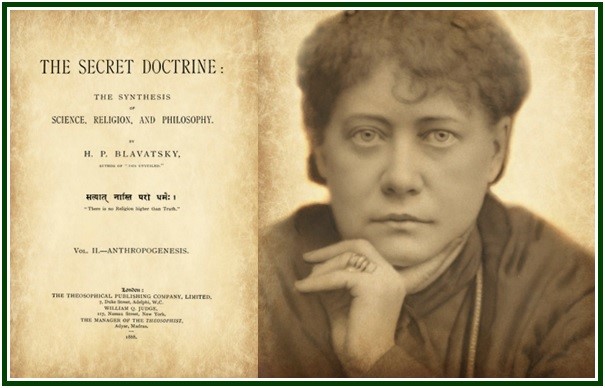
Helena Petrovna Blavatsky, 
no seu livro 
"A Doutrina Secreta, 
Síntese da Ciência, Religião e Filosofia", publicado em 1888. 


O Volume I é dedicado à cosmogenese, e é basicamente composto por estudos relativos à evolução do universo. O Volume II é dedicado à antropogénese, a origem e evolução da humanidade. Os dois volumes apresentam um resumo das ideias da Teosofia, movimento que Blavatsky ajudou a fundar. Um terceiro volume foi publicado pela Sociedade Teosófica após o falecimento de Blavatsky. Ele é composto de uma coletânea de vários artigos de Blavatsky.

Blavatsky alegava que não era a autora do livro, e que este teria sido escrito pelos Mahatmas Djwal Khull, Kut Humi e Morya, utilizando o seu corpo físico, num processo denominado Tulku do budismo tibetano. Ela alegou ter recebido suas informações durante transes nos quais os Mestres dos Mahatmas do Tibete se comunicaram com ela e permitiram que ela lesse o antigo Livro de Dzyan. 

O Livro de Dzyan foi supostamente composto na Atlântida usando a língua perdida senzar, mas a dificuldade é que nenhum estudioso de línguas antigas na década de 1880 ou desde então encontrou a menor referência passageira ao Livro de Dzyan ou à língua senzar.

Alegava que a obra era baseada em pergaminhos antigos (as Estâncias de Dzyan), a que teria tido acesso e estudado. Segundo Blavatsky, as "Estâncias de Dzyan" seriam um manuscrito arcaico, escrito numa coleção de folhas de palma, resistentes à água, ao fogo e ao ar, devido a um processo de fabricação desconhecido, e que conteriam registos de toda a evolução da humanidade, numa língua desconhecida pelos filólogos denominada Senzar. Foram feitas várias tentativas, sem sucesso, de descobrir este manuscrito, durante o século XX. Assim, permanece sem resposta se estes manuscritos realmente existiram ou não.

As "Estâncias de Dzyan", segundo Blavatsky, estão relacionadas com o "Livro dos Preceitos de Ouro" e com os "livros de Kiu-te", que são uma série de tratados do budismo.

Outros textos usados como referência por Blavatsky são os Livros Mosaicos, os textos sagrados hindus (como os Vedas, Brâmanas, Upanixades, e Puranas) e arianos (como o Vendidade), e a cabala caldeia e judaica. Blavatsky também foi influenciada pela mitologia antiga.

Para Blavatsky, existiu uma Religião-Verdade, que é a raiz de todas as religiões e mitos da humanidade.

As Estâncias do Livro de Dzyan, formam a base do livro "A Doutrina Secreta, Síntese da Ciência, Religião e Filosofia", que apresenta três conceitos fundamentais:
  1. A existência de um Princípio Omnipresente (Causa Infinita, Absoluto ou Raiz Sem Raiz), eterno, sem limites, imutável e incognoscível;
  2. A eternidade do universo, que passa por ciclos de atividade e inatividade que se repetem em sucessão sem início nem fim;
  3. A identidade de todas as almas com a alma universal, sendo esta última um aspecto da raiz desconhecida. 


Cosmogenese
A cosmogenese descreve a origem do cosmos, e de tudo que nele existe, a partir do Princípio Uno, e a sua posterior evolução.

Segundo Blavatsky, o Princípio Uno (a Deidade Una ou Absoluto) é idêntico ao conceito de Parabrahman dos vedantinos (assim como esta palavra, muitas expressões no livro aparecem escritas em sânscrito) e ao Ain Soph dos cabalistas. 
A Deidade Una é, ao mesmo tempo, Existência Absoluta e Não-Existência Absoluta. 
A única percepção que a nossa limitada consciência pode ter do Princípio Uno é entendê-lo como sendo o Espaço Absoluto Abstrato.

Importante observar que, para Blavatsky, este Princípio Uno não é o Deus criador das religiões monoteístas, pois sendo Absoluto e Não-Manifestado não pode criar. 
De acordo com o livro, o Deus "criador" é um coletivo de seres intra-cósmicos, emanados do Princípio Uno, que trabalhou sobre a matéria, ordenando-a. Blavatsky chama os seres divinos desta hierarquia de Dhyan-Chohans. Segundo ela, estes seres são chamados no livro do Genesis e na cabala judaica de Elohim.

Segundo a autora, a existência e evolução do Universo e dos planetas é uma alternância de períodos de atividade e inatividade, que ela chama de "Dias e Noites de Brahman".

No livro, a cosmogenese é descrita iniciando com a emanação de um Princípio da Deidade Una. Este Princípio, que Blavatsky chama de Brahman, diferencia-se em duas Forças opostas, Masculino-Feminino, Positivo-Negativo, que ela chama de Brahmâ
Esta Potência é a força "criadora" que, no início de um período de atividade (chamado por Blavatsky de manvantárico), acorda o universo e inicia um novo ciclo.

Segundo a cosmogenese apresentada no livro, dois elementos inseparáveis formam o universo: 
a Ideação Cósmica e a 
Substância Primordial (chamada por Blavatsky de Mulaprakriti e, segundo ela, referenciada no livro do Genesis como sendo o "Caos primordial"). 
Uma, positiva e ativa, a outra, negativa e passiva. 
A ideação pré-cósmica é a raiz de toda a consciência individual, e  
A substância pré-cósmica é o substrato da matéria em seus vários graus de manifestação.

Esta cosmogenese é descrita por Blavatsky como uma "fertilização imaculada" da natureza primordial pelo Espírito Universal. 
Ela descreve geometricamente isto por meio de um ponto inscrito num círculo (formando, segundo ela, a década pitagórica, o ponto representando no "1" e o círculo no "0"), e diz que 
"O Uno é um círculo não interrompido (anel) e sem circunferência, porque não está em parte alguma e está em toda a parte; o Uno é o plano sem limites do círculo, que manifesta um diâmetro somente durante os períodos manvantáricos; o Uno é o ponto indivisível, que não está situado em parte alguma, e percebido em toda parte durante aqueles períodos." 
in, A Doutrina Secreta

Uma força importante na formação do universo é Fohat, o "incessante poder formador e destruidor". 
Durante um período de inatividade do universo, no imanifestado antes da formação do cosmos objetivo, Fohat permanece latente e coeterno com Parabrahman e Mulaprakriti. 
Ele é o aglutinador de ambos, que liga e separa, sendo assim o desejo criador. 
No período de atividade, de manifestação do universo, Fohat torna-se o raio divino da criação que aplica a Ideação Cósmica no seio da Substância Primordial.


Ciclos e suas durações


Um Período de Atividade Cósmica, A IDADE TOTAL DE BRAHMA É DE: 311.040.000.000.000 (TREZENTOS E ONZE TRILHÕES E QUARENTA BILHÕES DE ANOS). 

UM DIA DE BRAHMA EQUIVALE À: 4.320.000.000 (QUATRO BILHÕES TREZENTOS E VINTE MILHÕES DE ANOS TERRESTRES). A NOITE É DE IGUAL DURAÇÃO; 

SENDO ASSIM, UM DIA DE BRAHMA (DIA E NOITE), OU, 
24 HORAS DA VIDA DE BRAHMA SERÁ IGUAL À: 8.640.000.000 (OITO BILHÕES SEISSENTOS E QUARENTA MILHÕES DE ANOS TERRESTRES).


No esquema da figura acima, apresentado no livro, toda a história da existência e evolução do universo e dos planetas desenvolve-se em ciclos ou períodos de tempo. 

Existem períodos de atividade e inatividade, chamados de Manvantaras e Pralayas, ou "Dias e Noites de Brahman". 
Os Manvantaras também são chamados de Kalpas.
Um período de 360 Dias e Noites de Brahman forma um "Ano de Brahman". 
Finalmente, 100 "Anos de Brahman" formam uma "Vida de Brahman", também chamada de Mahamanvantara (ou Mahâ Kalpa). 

A cada Mahamanvantara segue-se um período de igual duração em que o universo "dorme" até ser despertado no início de um novo ciclo. 
Este período de inatividade é chamado de Mahapralaya. 


Segundo o computo dos Brâmanes, 
um Mahamanvantara dura cerca de
  311.040.000.000.000 de anos.
TREZENTOS E ONZE TRILHÕES E QUARENTA BILHÕES DE ANOS

NO CAMPO DA ASTRONOMIA, 
OS CIÊNTISTAS CONCLUIRAM QUE 
O UNIVERSO TEM APROXIMADAMENTE 
A IDADE DE 13.700.000.000 
(TREZE BILHÕES E 700 MILHÕES DE ANOS)


Cadeia Planetária


Segundo "A Doutrina Secreta", todo corpo cósmico (planeta, estrela, cometa, etc.), é uma entidade formada por uma estrutura interna invisível e uma estrutura externa, frequentemente visível, chamada veículo físico ou corpo. 
Estes elementos, em número de sete (doze, se incluirmos os planos não manifestados, Rupa-Dathu), são os princípios da entidade, que Blavatsky chama de Globos. 

A evolução num corpo cósmico processa-se desde o primeiro Globo (Globo A), mais etéreo, descendo até o quarto Globo (Globo D), o mais denso de todos onde nós estamos na Terra, e daí subindo até o sétimo (Globo G), novamente etéreo. 
Este ciclo que percorre os sete Globos é chamado de cadeia planetária.


A evolução da cadeia planetária é composta por períodos chamados de Rondas. 
  • Quando um Globo passa por Sete Raças-raiz diz-se que ocorreu uma Ronda de Globo. 
  • Quando a evolução passa por todos os Sete Globos (ou doze se incluirmos os Globos localizados em planos não manifestados) de uma cadeia planetária, diz-se que ocorreu uma Ronda Planetária
  • Segundo Blavatsky, Sete Rondas Planetárias formam um Kalpa (ou Manvantara).


O livro ainda apresenta ciclos menores chamados de Yugas, que se sucedem na ordem: 
  1. Krita Yuga; 
  2. Tetrâ Yuga; 
  3. Dvâpara Yuga; e 
  4. Kali Yuga.


Antropogenese
A antropogenese descreve a origem e evolução da humanidade. 
Nela são descritas as diversas raças humanas (chamadas Raças-raiz) que já evoluíram neste planeta na atual Ronda.

Para Blavatsky, uma Monada-Espírito com o seu grupo de almas, evoluem no teatro da existência desde o início do Manvantara, até ao seu final, (7 Rondas Planetárias - 4.320.000.000 anos,  
QUATRO BILHÕES, TREZENTOS E VINTE MILHÕES DE ANOS TERRESTRES) quando então estas almas atingirão a perfeição espiritual, e retornam à sua Monada e à Fonte Cosmica. Assim, a Teosofia adota o conceito de transmigração das almas.


NO CAMPO DA ASTRONOMIA, 
OS CIÊNTISTAS CONCLUIRAM QUE 
O UNIVERSO TEM APROXIMADAMENTE 
A IDADE DE 13.700.000.000 
(TREZE BILHÕES E 700 MILHÕES DE ANOS)

O NOSSO SISTEMA SOLAR 
TEM APROXIMADAMENTE  
QUATRO BILHÕES E MEIO DE ANOS
DE ACORDO COM OS CÁLCULOS 
DA CIÊNCIA ORTODOXA, 
ISTO REPRESENTA APENAS 
12 HORAS NA VIDA DE BRAHMA.


Transmigração é uma doutrina filosófica de origem indiana, transportada para o Egito, de onde mais tarde Pitágoras a importou para a Grécia. 
Os discípulos desse filósofo ensinavam que uma alma, depois de um período longo no Campo Energético Subtil, volta sucessivamente à Matéria para animar outros corpos de seres humanos ou de animais, até que transcorra o tempo de sua purificação e possa retornar à fonte cósmica.

Como se constata, há uma diferença capital entre a metempsicose e a doutrina da reencarnação: 
em primeiro lugar, a metempsicose admite a transmigração da alma para o corpo de animais, o que seria, para os espíritas, uma degradação; 
em segundo lugar, essa transmigração apenas acontece na Terra. Os espíritas lecionam o contrário, que a reencarnação é um progresso constante, que o homem é um ser cuja alma nada tem de comum com a dos animais, que as diferentes existências podem realizar-se quer na Terra, quer, por uma lei progressiva, em mundos de dimensões vibracionais superiores, até que a alma se torne um espírito purificado.

A transmigração observa a regularidade do desenvolvimento biológico em primeiro plano. 
De acordo com a tradição espiritualista esotérica, uma alma pode vir a ser condenada a passar a reencarnar em corpos animais subhumanos caso se densifique. 
Além disso, nos casos de perda planetária e consequente transmigração planetária, pode ocorrer humanidades inteiras passarem a reencarnar sob a forma de entidades infra-humanas como dinossauros ou mesmo trilobites, por exemplo.

O livro afirma que evoluem no nosso Globo sete grupos humanos, em sete regiões diferentes do Globo. Assim, Blavatsky defende uma origem poligenética do Homem.
A tese revolucionária de Blavatsky é, numa época que não se supunha o Homem mais antigo que 100 mil anos, afirmar que: 

O Ser Humano físico 
tem mais de 
18 milhões de anos de existência.

Cada Alma
materializa-se em sucessivas vidas
DURANTE 
QUATRO BILHÕES, TREZENTOS E VINTE MILHÕES DE ANOS TERRESTRES
Até regressar à sua Monada e, à Fonte Cosmica


A antropogenese, descrita em "A Doutrina Secreta", opõe-se à evolução darwinista que era largamente aceite na época. 

Blavatsky não nega o mecanismo da evolução, mas não aceita que uma "força cega e sem objetivo" possa ter resultado no aparecimento do Homem. 
Para ela, a criação do Homem deu-se por meio de esforços conscientes de seres divinos, que ela chama de Dhyan-Chohans, que são a origem da Mônada que habita todo ser humano.

Blavatsky não nega que a evolução dos animais e do Homem estão relacionadas. 
No entanto, ela alega que os homens não são primatas, como afirma a teoria da evolução. 
Ao contrário, para Blavatsky, os primatas são descendentes de antigas raças humanas que se degeneraram, ou seja, os primatas descendem do homem.

Segundo o livro, a criação e evolução do Homem ocorre de forma semelhante à cosmogenese. 
Então, cada evento que ocorreu na cosmogenese tem o seu equivalente na antropogenese. 

Assim, por exemplo, também o Homem é hermafrodita em seus primeiros estágios (como o Brahmâ Masculino-Feminino da cosmogenese), até que se divide em Macho e Fêmea no final da terceira Raça-raiz (Lemuriana) e início da quarta raça, que Blavatsky chamou de Atlante. 
Segundo a autora, este fato está relatado de forma alegórica no livro do Genesis, quando ele relata o momento em que Deus retira a mulher da costela de Adão.

Como no caso da cadeia planetária, em que o ciclo de existência e evolução desce desde o primeiro Globo, mais etéreo, até o quarto Globo, o mais denso, para então retornar até ao sétimo, novamente etéreo, também a evolução humana se processa num ciclo que inicia com a primeira raça que era etérea, até a Lemuriana (a terceira raça), a primeira raça a possuir corpo físico, e então retornando até a sétima raça que será novamente etérea.

A criação do Homem é apresentada como uma "queda na matéria". 
Blavatsky inspira-se nos mitos de "rebelião nos céus" do Catolicismo e na mitologia grega, com Prometeu, que rouba o fogo de Vulcano para dar vida aos homens (que haviam sido criados por seu irmão Epimeteu, que não fora capaz de lhes dar a consciência) e é condenado por Zeus a ficar acorrentado no Cáucaso. 
Para Blavatsky, estes mitos são ecos de antigas tradições sobre a queda dos seres divinos na humanidade primitiva, para dar aos homens a alma imortal, a consciência divina.

Para Blavatsky, a criação do Homem é dual. 
Primeiro foram feitos seus princípios inferiores (pelos Elohim inferiores), 
depois lhe foi infundido o "sopro de vida", sua Alma Imortal, sua consciência.

Seres divinos mais avançados, chamados, no livro, de Kumaras, foram incumbidos com a tarefa de criar o Homem: no entanto, eles se negaram a fazê-lo pois, sendo demasiadamente espirituais, eram incapazes de criar o Homem físico. 

Assim, hierarquias de seres menos avançados (os Pitris lunares) criaram o Homem, emanando-o a partir de seu próprio corpo astral (que serviu como molde). Eram, contudo, incapazes de lhe dar sua Alma Imortal, a consciência. 

Então, os Kumaras, associando-se a estes seres humanos primitivos, forneceram o sopro divino (como no Genesis, quando Deus coloca o sopro de vida no Adão "feito de barro"), a Alma Imortal do Homem. Acabaram condenados a ficar presos na matéria, como o Prometeu acorrentado no Cáucaso.

Ecos destes eventos aparecem de forma alegórica, segundo Blavatsky, no mito Católico da "rebelião nos céus" e na "expulsão dos anjos maus". Estes "anjos maus" ou "rebeldes" são aqueles que se recusaram a criar e foram "expulsos dos céus" e "lançados no abismo" (a matéria). 
Então, no dizer de Blavatsky, os deuses tornaram-se não-deuses, os suras tornaram-se asuras.


Os sete princípios do Homem


Um princípio, para a Teosofia, é um começo, um fundamento, uma fonte e uma essência de onde as coisas procedem. Princípios são assim as essências fundamentais das coisas. Estes princípios, tanto no Homem quanto na natureza, são teosoficamente enumerados como sete.

Segundo a Teosofia, o sete é o número fundamental da manifestação, frequentemente encontrado em diferentes cosmogonias, assim como nos dogmas de diversas religiões e na tradição de muitos povos antigos.


O Homem, assim como a natureza, é chamado de saptaparna (planta de sete folhas), simbolizado geometricamente por um triângulo sobre um quadrado. Nesta constituição setenária, podemos entender o Atman como a coroa que encima a constituição humana (a ponta superior do triângulo), fornecendo-lhe o seu espírito imortal.

ATMAN - MONADA
BUDHI - ESPÍRITO
MANAS - SUPERALMAS (Superior) E ALMAS(inferior)


Segundo Blavatsky, o Absoluto emana de si raios, que são chamados, no livro, de Monadas ou Atman. 

Estas Monadas 
são a Essência Imortal do Homem. 
Assim, a Essência que forma o Homem, 
a sua Monada, 
é da mesma natureza do Absoluto, 
a Deidade Una e indivisível, 
que tem um só Espírito.


O Atman, com o objetivo de individualizar-se, emana de si um princípio mais denso chamado Budhi(Espírito)  
Esta díade Atman-Budhi reveste-se de princípios cada vez mais densos, holográficos e fractais, de forma a elevar-se e evoluir energeticamente, e cada alma do Núcleo Monádico é formada por 7 corpos:

  1. Sthula Sharira - O corpo físico, corpo denso;
  2. Linga Sharira - O corpo astral, duplo etérico;
  3. Prâna - O corpo vital;
  4. Kâma-Manas - Nossa Alma Humana, Mente Inferior, dominada pelo desejo.
  5. Manas - Nossa SuperAlma Humana, Mente Superior, tendo relação com Mahat, Mente Universal. É o elo entre a Díade Atman-Budhi e nossos princípios inferiores;
  6. Budhi - Puro Espírito;
  7. Atman - Primeira irradiação de Atman ou Ovo Áurico. Monada, Essência Cósmica.

Está cientificamente comprovado  através da Teoria do Campo Unificado de Albert Einstein,  e também através da Física Quântica,  que tudo no Cosmos é Holográfico e Fractal. 
Também o nosso Núcleo Monadico é holográfico e fractal.


Raças-raiz
Segundo a autora, os primeiros homens não possuíam um corpo denso
As primeiras raças tinham um corpo sutil, etéreo, imenso e ainda sem forma bem definida. 
À medida que avançou a evolução do Homem, o seu corpo tornou-se mais denso numa sucessão de estágios, assumindo a forma que tem hoje.

As cinco Raças-raiz apresentadas no livro são:

  1. "Nascidos por Si Mesmos" ou "Sem Mente" - Esta raça apareceu há 300 milhões de anos e viveu em um continente que Blavatsky chamou de "A Ilha Sagrada e Imperecível". Os homens desta raça eram imensos e não possuíam nem corpo físico (eram seres etéreos), nem mente. A reprodução ocorria por cissiparidade (algo semelhante ao que ocorre com as amebas). Como esta raça não era mortal, ela não desapareceu, apenas converteu-se na próxima, os "Nascidos do Suor";
  2. "Nascidos do Suor" ou "Sem Ossos" - Eles viveram em um continente chamado "Hiperbórea". Nesta raça apareceu um rudimento de mente, no entanto, ainda não havia uma ponte entre espírito e matéria para a mentalidade. Ao final do seu período de evolução, esta raça converteu-se na seguinte, a "Nascidos do Ovo". As duas primeiras raças são chamadas de raças semidivinas;
  3. "Nascidos do Ovo" ou "Lemuriana" - Viveram em um continente chamado "Lemúria". Esta raça era inicialmente hermafrodita e reproduziam-se por meio de um ovo que se desprendia do corpo. Esta raça passou por grandes transformações durante o seu período evolutivo. Ao final do seu período, o Homem tornou-se mortal, consolidando-se o corpo físico e a reprodução sexuada como se conhece hoje (então esta raça desapareceu, convertendo-se na raça atlante);
  4. "Atlante" - Eles são os gigantes que viveram há 18 milhões de anos, em um continente chamado "Atlântida" A raça atlante representou o ponto mediano da evolução nesta atual Ronda. A Atlântida, assim como os seus habitantes, foi destruída por um cataclismo;
  5. "Ariana" - Segundo Blavatsky, a raça Ariana, a atual raça-raiz, existe há aproximadamente 1 milhão de anos.
Respondendo por que não foram encontrados registos fósseis das raças anteriores à ariana, Blavatsky alega que as primeiras raças eram etéreas, sem corpo denso que pudesse deixar fósseis. Quanto à raça atlante, disse que os fósseis estavam no fundo do oceano, à espera de serem encontrados.

Estamos atualmente na Quinta Etapa, da Quarta Ronda no Planeta Terra, conhecido como “arianos”. 
Os arianos (a palavra significa “nobre” em sânscrito) eram as tribos nomadas indo-europeias originais. Uma raça guerreira de cavaleiros que se mudou para o leste para a Índia. E o oeste para o leste e a Europa. Os historiadores argumentam que, quando chegaram à Europa, destruíram as sociedades matriarcais pagãs e pacíficas e de sabedoria da terra. Substituíram por sociedades patriarcais que adoravam o deus do céu, como a guerra, como ainda temos hoje.

É lamentável que o termo “ariano” tenha sido adotado e pervertido por Hitler. 
As fantasias do seu predecessor intelectual de um “Super-homem ariano” e, que ainda seja usado hoje por extremistas de direita. Hitler e seu círculo íntimo também perverteram alguns antigos símbolos genuínos, como a suástica. Um antigo símbolo sânscrito, usando-o no sentido anti-horário. 
No entanto, as suásticas na Índia, no Tibete e em outros lugares também, são representadas às vezes no sentido anti-horário, bem como no sentido horário.

Houve na Terra muitas civilizações das quais nada sabemos. 
Essas raças evoluem da eterealidade à materialidade. 
Todas as espécies orgânicas vivas de animais e vegetação mudam a cada nova raça-raiz.

Cada sub-raça e nação têm os seus ciclos e estágios de evolução do desenvolvimento repetidos numa escala menor. A nossa raça, como uma raça-raiz, cruzou a linha média das raças-raiz e está a avançar para o lado espiritual. Mas algumas sub-raças ainda se encontram no arco descendente sombrio dos seus respetivos ciclos nacionais. Outros ainda, os mais velhos, tendo cruzado o seu ponto crucial, estão já no ápice do desenvolvimento espiritual como sub-raças.

"A humanidade está obviamente dividida em homens informados e criaturas humanas inferiores. A diferença intelectual entre os arianos e outras nações civilizadas e selvagens como os habitantes das ilhas do Mar do Sul é inexplicável por qualquer outro motivo. Nenhuma cultura, nem gerações de treinamento em meio à civilização, poderiam elevar espécimes humanos como os bosquímanos, os Vedas do Ceilão e algumas tribos africanas ao mesmo nível intelectual que os arianos, semitas e os chamados turanianos. A "centelha sagrada" está faltando neles e são eles as únicas raças inferiores no globo, agora felizmente - devido ao ajuste sábio da natureza que sempre trabalha nessa direção - morrendo rapidamente. Na verdade, a humanidade é "de um só sangue", mas não da mesma essência. Nós somos a estufa, plantas artificialmente aceleradas na natureza, tendo em nós uma centelha, que nelas está latente.
(...)
Dessas criaturas semi-animais, os únicos remanescentes conhecidos pela Etnologia foram os tasmanianos, uma parte dos australianos e uma tribo das montanhas na China, cujos homens e mulheres são inteiramente cobertos de pêlos. Eles foram os últimos descendentes de uma forma direta linha dos lemurianos dos últimos dias semi-animais referidos. Há, no entanto, um número considerável de povos mistos Lemuro-Atlantes produzidos por vários cruzamentos com tais linhagens semi-humanas - por exemplo, os homens selvagens de Bornéu, os Vedas do Ceilão , classificado pelo Prof. Flower entre os arianos, a maioria dos australianos restantes, bosquímanos, negritos, selvagens das Ilhas Andamão, etc."
Blavatsky


Blavatsky também afirma que "a doutrina ocultista não admite divisões como o ariano e o semita, aceitando até mesmo o turaniano com amplas reservas. Os semitas, especialmente os árabes, são arianos mais tardios - degenerados em espiritualidade e perfeitos em materialidade". 
Ela também conecta a raça física com atributos espirituais constantemente ao longo de suas obras:
"A história esotérica ensina que os ídolos e sua adoração morreram com a Quarta Raça, até que os sobreviventes das raças híbridas desta (chineses, negros africanos etc.) gradualmente trouxeram a adoração de volta. Os Vedas não apresentam ídolos; todos os escritos hindus modernos apresentam."
Blavatsky


De acordo com Blavatsky, 
"Os Monadas dos espécimes mais baixos da humanidade (o selvagem de "cérebro estreito" das ilhas do mar do sul, o africano, o australiano) não tinham Carma para desenvolver quando nascidos como homens, como seus irmãos mais favorecidos em inteligência tinha". 

Ela também profetiza sobre a destruição das "falhas da natureza" raciais à medida que a "raça superior" ascende:
"Assim, a humanidade, raça após raça, realizará seu ciclo de peregrinação designado. Os climas vão, e já começaram, a mudar, a cada ano tropical após o outro, eliminando uma sub-raça, mas apenas para gerar outra raça superior no ciclo ascendente ; enquanto uma série de outros grupos menos favorecidos - os fracassos da natureza - irão, como alguns homens individualmente, desaparecer da família humana sem mesmo deixar rastro para trás."


O modelo de Blavatsky foi desenvolvido por teosofistas posteriores, sendo os mais notaveis:
  1. William Scott-Elliot. The Story of Atlantis (1896) The Lost Lemuria (1904). 
  2. Annie Besant desenvolveu ainda mais o modelo em Man: Whence, How and Whither (1913). Besant e Scott-Elliot confiaram as informações de Charles Webster Leadbeater obtido por “clarividência astral”. 
  3. Elaboração posterior foi fornecida por Rudolf Steiner em Atlantis and Lemuria (1904). 

Rudolf Steiner, e os autores teosofistas subsequentes, chamaram os períodos de tempo associados a essas raças de, Épocas. (Steiner achava que o termo “raça” não era mais adequado para a humanidade moderna).